Skip to content
Fire Rescue Pedia | Knowledge for life

Fire Rescue Pedia | Knowledge for life

Free & Open Source for Fire & Rescue Articles

  • Αρχική | Home
  • ΚΑΤΗΓΟΡΙΕΣ
    • Υγιεινή & Ασφάλεια
    • Ιστορία
    • Πυρόσβεση & Πυρασφάλεια
    • Πυρανίχνευση
    • Ανίχνευση Αερίων
    • Πρώτες Βοήθειες
    • Δασοπροστασία
    • Τεχνική Διάσωση
    • Συμβουλές
    • Τεχνολογία
    • Haz.Mat – CBRNE
  • ΣΕΜΙΝΑΡΙΑ – ΕΚΠΑΙΔΕΥΣΕΙΣ
  • ENGLISH
    • SPECIAL Articles
  • Quiz – Τέστ γνώσεων
  • Home
  • Special Articles in English
  • First Aid in Confined Spaces: Why “Rescue First, Treat Second” Saves Lives
  • Special Articles in English

First Aid in Confined Spaces: Why “Rescue First, Treat Second” Saves Lives

6 min read
101
Κοινοποιήστε στα Social ή εκτυπώστε το άρθρο
Αξιολογήστε το άρθρο!
[Σύνολο: 1 Μέσο: 5]
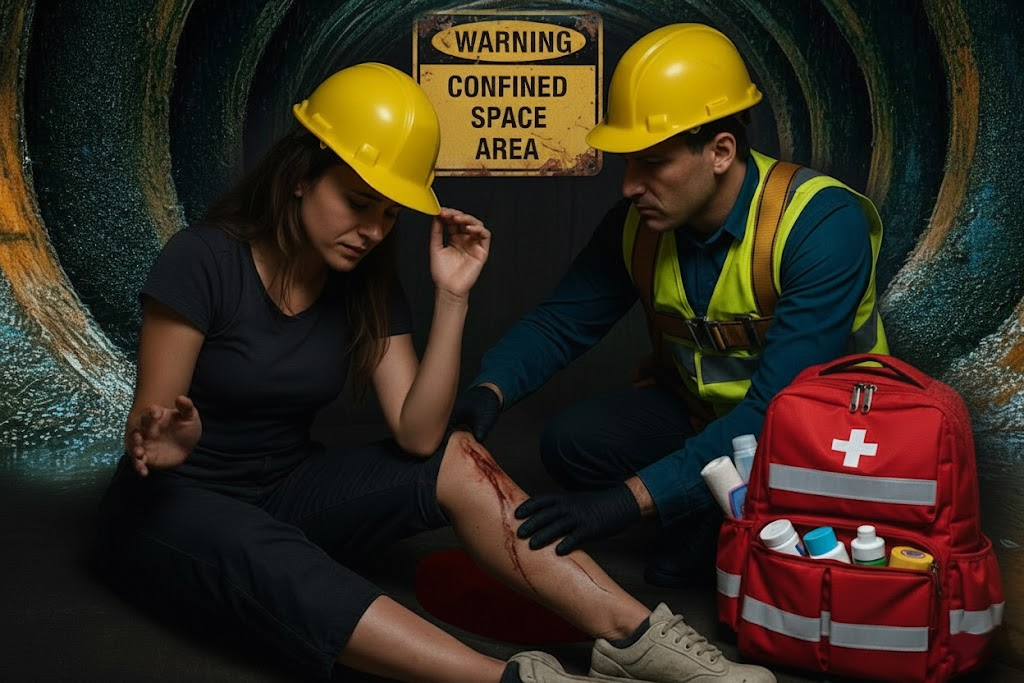
Image concept & creation by John Retsios

When people hear “first aid at work,” they picture a well-lit factory floor, a clean airway assessment, and a quick phone call to emergency services. Confined spaces are nothing like that.
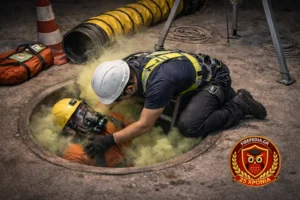
Tanks, tunnels, silos, culverts, and sewers compound medical problems with unique environmental threats: toxic or oxygen-poor atmospheres, restricted access, entrapment, noise, poor visibility, and the ever-present risk of creating multiple casualties through attempted self-rescue or improvised entry.

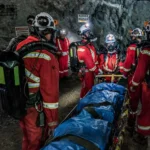
This article takes a clear stance: first aid should not be performed inside a confined space unless it is delivered by a properly equipped and competent rescue team operating under a safe system of work.
For everyone else, the ethic is simple and uncompromising: rescue to a place of safety first; treat second.

The Four Gases Everyone Talks About—and Why They Matter

Most confined space monitoring regimes focus on four gases because they account for the majority of immediately dangerous atmospheres:

  1. Oxygen (O₂) – Too little and patients (and would-be rescuers) lose consciousness rapidly; too much and fire risk escalates. Oxygen concentration can change quickly and unpredictably.
  2. Hydrogen sulphide (H₂S) – A highly toxic gas that paralyzes the olfactory nerve; the “rotten egg smell” is not a reliable warning. Even short, high-dose exposures can cause sudden collapse.
  3. Carbon monoxide (CO) – Colourless, odourless, binds to haemoglobin far more readily than oxygen, starving tissues despite a “normal” respiratory effort and pink skin tone.
  4. Methane (CH₄) – Typically discussed for its explosivity and displacement of oxygen rather than inherent toxicity; any ignition source becomes a major threat.

Normal workplace first aid courses do not equip you to diagnose, mitigate, or safely treat gas-related injuries in a hazardous atmosphere. Recognising that someone is hypoxic or poisoned is not the same as safely entering, ventilating, monitoring, and extricating them.

Why Standard First Aid Training Falls Short in Confined Spaces

General first aid courses are designed for open, safe environments.
They assume:

  • Accessible patient in breathable air,
  • Stable scene without dynamic atmospheric risk,
  • Rapid external help en route,
  • Minimal PPE requirements.

Confined spaces violate all four assumptions. To treat safely inside the space, responders need far more than “first aid”:

  • Atmospheric monitoring competence (pre-entry and continuous, with alarm interpretation and response).
  • Ventilation strategies and an understanding of how airflow moves in that specific geometry.
  • Permit-to-work literacy and lockout/tagout integration.
  • Technical rescue capability (rigging, hauling, packaging, casualty handling in restricted layouts).
  • Breathing apparatus (often SCBA) with training, fit testing, duration calculations, emergency procedures, and team stepping.
  • Command, communication, and contingency planning (including non-entry rescue options and abort criteria).

Without these, attempting “treatment” inside the hazard zone is not first aid, it’s an uncontrolled rescue attempt that commonly ends in a second victim.
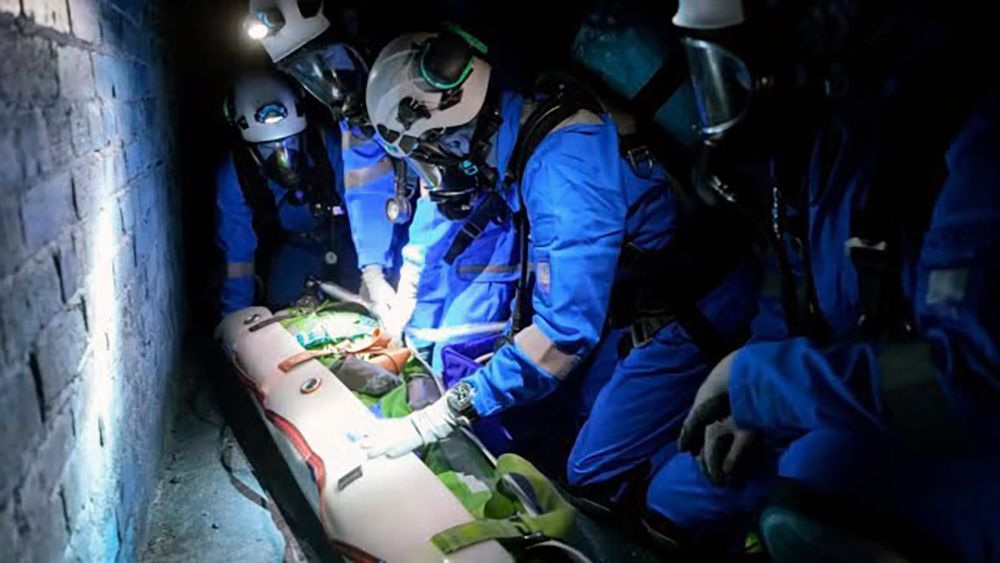
“Should We Ever Send Someone In for Medical Interventions?”

Only if all the following are true:

  • There is a formal rescue plan (written, briefed, rehearsed) that includes medical interventions within the space.
  • Trained, equipped rescue personnel are present (not just workers with a first aid card).
  • Continuous monitoring is in place with competent interpretation and action thresholds.
  • Appropriate RPE (usually SCBA) is available, serviceable, and used by personnel with current competence.
  • A safe system of work (permit, isolations, LOTO, ventilation, attendant, communications, retrieval) is active.
  • Abort criteria are clear and binding (gas alarms, comms failure, line tension anomalies, time-on-air limits, deteriorating conditions).

In other words, medical care inside the space is a rescue function, not a first aid function. If your team cannot satisfy the above, do not enter.

First Aid Is Exactly What It Says on the Tin: First, Not Final

First aid is initial care to preserve life, prevent deterioration, and promote recovery until more definitive help arrives. In confined spaces, that “initial care” begins with making the scene safe and initiating a rescue to fresh air. Once the casualty is out:

  • Airway & Breathing: Prioritise airway positioning, suction if available, high-flow oxygen if trained and authorised, and ventilation support if indicated.
  • Circulation & Haemorrhage: Control catastrophic bleeding immediately (pressure, haemostatic dressings, tourniquet when appropriate). Manage shock aggressively (warmth, minimal movement if spinal risk).
  • Gas Exposure Considerations: Suspected CO or H₂S exposure? High-flow oxygen and rapid handover to advanced care. Do not delay evacuation for “on-scene” treatments you’re not equipped to deliver.
  • Packaging & Handover: Patient packaging should facilitate rapid movement and ongoing monitoring; handover should include atmospheric readings, time in space, and PPE used.

Inside the space, any attempt to do these tasks without the capabilities listed earlier is unsafe.

The Safe Person Concept—Preached Exhaustively, Practised Relentlessly

The Safe Person Concept is non-negotiable:

  1. Your safety. You are no use as a second casualty.
  2. Your team’s safety. Don’t compromise a whole crew for a single improvised act.
  3. Then the casualty’s welfare. A living, breathing rescuer outside the space is the casualty’s best chance of survival.

If you feel panic rising, default to protocol:

  • Stop. Breathe. Check alarms and time.
  • Confirm comms with the attendant/top person.
  • Re-verify the plan or initiate the emergency plan.
  • Request the designated rescue team if not already on standby.

Panic makes bad physics worse. Gas doesn’t negotiate.

Self-Rescue and Co-Worker Rescue: The Multiplying Risk

Many fatalities occur when co-workers attempt spontaneous rescue. Common patterns:

  • A worker collapses; a colleague rushes in unprotected and collapses; a third follows…
  • A space is “quiet yesterday, so it’s probably fine,” and monitoring is skipped.
  • The team relies on smell to detect H₂S or “feels normal” breathing to dismiss CO.

Break the chain: if you don’t have the equipment, competence, and plan to enter, don’t. Call the rescue team and manage the scene from safety.

So… Should First Aid Be Considered In a Confined Space?

Yes, by a trained, equipped confined space rescue team working to a rehearsed plan.

No, by general first aiders or co-workers without that capability.

For most workplaces, the correct model is:

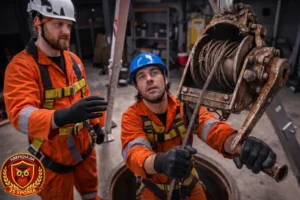
  • Plan for non-entry rescue first. Use retrieval systems (tripods, davits, winches) and continuous monitoring to avoid committing personnel.
  • If entry rescue is foreseeable, it requires dedicated training, equipment, staffing, and governance. That’s a rescue programme, not a first aid add-on.
  • First aid belongs at the point of safety after extraction—where air is breathable, lighting is workable, and risk is manageable.

Practical Framework for Employers and Teams

Before work begins

  • Hazard identification & risk assessment specific to the space and task.
  • Permit-to-work with isolation/LOTO and ventilation plan.
  • Rescue plan proportionate to the risk (non-entry preferred; entry only with full capability).
  • Competence assurance: entrants, attendants, supervisors, and (if applicable) rescue technicians.
  • Equipment readiness: calibrated gas monitors, retrieval systems, comms, SCBA, medical kit appropriate to foreseeable injuries.

During operations

  • Continuous monitoring with documented readings and alarm responses.
  • Strict role separation: attendant does not enter; entrants do not become rescuers ad hoc.
  • Time-on-air and reliefs controlled where BA is in use.
  • Abort early if alarms, comms failures, or conditions deteriorate.

If an incident occurs

  • Activate the rescue plan—not improvisation.
  • Prioritise extraction to safety.
  • Deliver first aid outside the hazard, focusing on airway, breathing (oxygen where approved), and catastrophic haemorrhage.
  • Clinical handover includes atmospheric data and exposure timelines.

A Short Word on Kit Creep

It’s tempting to “upgrade” first aid kits with oxygen, suction, airway adjuncts, and haemostatics. Equipment without competence and context can become a liability. Match kit to your plan and training, not the other way around.

Bottom Line

  • First aid inside a confined space is a rescue task, not a basic skill.
  • Rescue first, treat second is the doctrine that prevents multiple fatalities.
  • Safe Person Concept isn’t a slogan—it’s the rule of survival: you, your team, then the casualty.

If your current arrangements imply that a standard first aider will “sort things out” inside the space, you don’t have a first aid problem—you have a rescue planning problem. Fix the plan, build the capability, rehearse the response, and keep your people alive.

If your team works in confined spaces, don’t leave emergency response to chance. Overwatch Response provides professional standby rescue teams and on-site paramedic support for high-risk operations.

  • Confined space standby rescue
  • Working at height rescue
  • Industrial and chemical environments
  • Onsite paramedics and advanced medical care
  • Professional technical rescuers from emergency services backgrounds
  • Full rescue planning, compliance and risk reduction

Protect your people. Protect your business. Don’t let your team become the rescue plan.

Article by Mark Hyland MA

Founder & CEO | Emergency Response & Rescue Standby Services | Safety Training & Risk Assessments
Αξιολογήστε το άρθρο!
[Σύνολο: 1 Μέσο: 5]

Continue Reading

Previous: Φθοριούχοι Αφροί Πυρόσβεσης: Χρήση, Κίνδυνοι και Περιβαλλοντική Διαχείριση
Next: Συστήματα PAPR: Λειτουργία, Πρότυπα και Εφαρμογές στη Βιομηχανία

Trending

The Vital Role of Incident Command in Firefighting: A Global Perspective 1

The Vital Role of Incident Command in Firefighting: A Global Perspective

Σωλήνες Πυρόσβεσης: Σύγχρονες Προδιαγραφές, Υλικά και Πρακτικές Χρήσης 2

Σωλήνες Πυρόσβεσης: Σύγχρονες Προδιαγραφές, Υλικά και Πρακτικές Χρήσης

Οδηγίες για τον ασφαλή χειρισμό του υγραερίου από την Πετρογκάζ 3

Οδηγίες για τον ασφαλή χειρισμό του υγραερίου από την Πετρογκάζ

Το πρώτο τροχαίο ατύχημα στην Ελλάδα 4

Το πρώτο τροχαίο ατύχημα στην Ελλάδα

Chemical Protective Suits Communication Guide: Seven Essential Hand Signals 5

Chemical Protective Suits Communication Guide: Seven Essential Hand Signals

Οξεία Μέθη και Αλκοολική Δηλητηρίαση: Οδηγός Πρώτων Βοηθειών 6

Οξεία Μέθη και Αλκοολική Δηλητηρίαση: Οδηγός Πρώτων Βοηθειών

Related Stories

The Vital Role of Incident Command in Firefighting: A Global Perspective
6 min read
  • Special Articles in English
  • Συμεών Μπανός

The Vital Role of Incident Command in Firefighting: A Global Perspective

17
Chemical Protective Suits Communication Guide: Seven Essential Hand Signals
7 min read
  • Special Articles in English
  • Ιωάννης Ρέτσιος

Chemical Protective Suits Communication Guide: Seven Essential Hand Signals

29
Managing Industrial Electrical Fires
4 min read
  • Special Articles in English

Managing Industrial Electrical Fires

23

Χορηγούμενη

Search&Rescue

Πυροσβεστικό Σώμα

Χορηγούμενη

Search&Rescue

Τελευταία άρθρα

The Vital Role of Incident Command in Firefighting: A Global Perspective 1

The Vital Role of Incident Command in Firefighting: A Global Perspective

Σωλήνες Πυρόσβεσης: Σύγχρονες Προδιαγραφές, Υλικά και Πρακτικές Χρήσης 2

Σωλήνες Πυρόσβεσης: Σύγχρονες Προδιαγραφές, Υλικά και Πρακτικές Χρήσης

Οδηγίες για τον ασφαλή χειρισμό του υγραερίου από την Πετρογκάζ 3

Οδηγίες για τον ασφαλή χειρισμό του υγραερίου από την Πετρογκάζ

Το πρώτο τροχαίο ατύχημα στην Ελλάδα 4

Το πρώτο τροχαίο ατύχημα στην Ελλάδα

Chemical Protective Suits Communication Guide: Seven Essential Hand Signals 5

Chemical Protective Suits Communication Guide: Seven Essential Hand Signals

Οξεία Μέθη και Αλκοολική Δηλητηρίαση: Οδηγός Πρώτων Βοηθειών 6

Οξεία Μέθη και Αλκοολική Δηλητηρίαση: Οδηγός Πρώτων Βοηθειών

Πυρίμαχες Κουβέρτες: Τι Είναι, Πώς Λειτουργούν και Πότε Χρησιμοποιούνται 7

Πυρίμαχες Κουβέρτες: Τι Είναι, Πώς Λειτουργούν και Πότε Χρησιμοποιούνται

Managing Industrial Electrical Fires 8

Managing Industrial Electrical Fires

Τεστ γνώσεων | Τι κάνετε αν πάρει φωτιά το όχημα σας 9

Τεστ γνώσεων | Τι κάνετε αν πάρει φωτιά το όχημα σας

Σακίδιο Εκτάκτου Ανάγκης – Οδηγός προετοιμασίας για την οικογένεια 10

Σακίδιο Εκτάκτου Ανάγκης – Οδηγός προετοιμασίας για την οικογένεια

RSS News

  • «Πιστό, λεπτό χρυσάφι» 16.11.2025
    Μια διαδρομή μισού αιώνα, που περιλαμβάνει σχεδόν εξακόσια ποιήματα, καταθέτει στη συγκεντρωτική υπό συζήτηση έκδοση του ποιητικού έργου του ο Γιώργος Βέης (γεν. 1955).
  • Λογοτεχνίας το ανάγνωσμα 16.11.2025
    Σε πρόσφατη συζήτηση με φίλες και φίλους, ο λόγος ήρθε και στη λογοτεχνία. Αφορμή να ανάψουν τα αίματα (που λέει ο λόγος…), η απονομή του Νομπέλ στον Λάσλο Κρασναχορκάι. Παρεμπιπτόντως, ο Κρασναχορκάι είναι ασφαλώς δύσβατος συγγραφέας, αλλά κατά τη γνώμη μου γράφει καλή λογοτεχνία.
  • Ο Γιάννης Αλαφούζος εφ’ όλης της ύλης για τον Παναθηναϊκό 16.11.2025
    «Το όραμά μου για τον Παναθηναϊκό είναι πρωτάθλημα, βιωσιμότητα και νέο γήπεδο», τόνισε ο Γιάννης Αλαφούζος σε μία συνέντευξη στην οποία άνοιξε όλη τη βεντάλια των θεμάτων που αφορούν την ΠΑΕ.
  • 500 Λέξεις με την Λήδα Ρουμάνη 16.11.2025
    Η «Πόρτα ανοιχτή» είναι η πρώτη της ποιητική συλλογή και κυκλοφόρησε πρόσφατα από τις εκδόσεις Καστανιώτη.
  • Γιάννης Αλαφούζος για Παναθηναϊκό: Ο Μπενίτεθ, ο Γιοβάνοβιτς και το νέο γήπεδο 16.11.2025
    Σε μια συνέντευξη που είχε προαναγγείλει από το καλοκαίρι, ο Γιάννης Αλαφούζος άνοιξε όλο το εύρος των αποφάσεών του για τον Παναθηναϊκό – των λαθών, των σχεδίων και των επιδιώξεων, που καθορίζουν το παρόν και το μέλλον της ΠΑΕ.
  • Μουσική δωματίου υψηλών προδιαγραφών 16.11.2025
    Ο Πίνχας Τσούκερμαν μαζί με ταλαντούχους νέους μουσικούς ερμήνευσαν σημαντικά έργα του βασικού ρεπερτορίου.
  • HOME CINEMA: Το «τέρας» που αγαπάει ο Ντελ Τόρο 16.11.2025
    Ο σπουδαίος Γκιγιέρμο ντελ Τόρο πραγματοποιεί μια επιθυμία ζωής, μεταφέροντας στην οθόνη τον αγαπημένο μύθο του με το δικό του, μοναδικό κινηματογραφικό στυλ, σε ένα φιλμ που βλέπουμε στην πλατφόρμα του Netflix.
  • Ρήξη Τραμπ – Γκριν για τον «φάκελο Eπσταϊν» ενόψει της ψηφοφορίας στη Βουλή 16.11.2025
    Η αντιπαράθεση ανάμεσα στον πρόεδρο Τραμπ και τη Ρεπουμπλικανή βουλευτή Ματζόρι Τέιλορ Γκριν βαθαίνει.
  • Φιαμέτα Ρόκο: Μια αθόρυβη επανάσταση στην ανάγνωση 16.11.2025
    Οι νέες τάσεις στη μεταφρασμένη λογοτεχνία, οι δυνατότητες της τεχνητής νοημοσύνης και η αποδυνάμωση της λογοτεχνικής κριτικής.
  • Γκέραλντ Κνάους στην «Κ»: Θα αποτύχουμε ξανά στο μεταναστευτικό 16.11.2025
    Ο πρόεδρος της Ευρωπαϊκής Πρωτοβουλίας Σταθερότητας, προβλέπει ότι και το νέο σχέδιο της Ε.Ε. για το μεταναστευτικό θα αποτύχει.
  • «Ο Λεβαδειακός δεν θα γίνει ξανά ασανσέρ» 16.11.2025
    Η ομάδα της Βοιωτίας εντυπωσιάζει, έχοντας την καλύτερη επίθεση στο πρωτάθλημα. Ο προπονητής της Νίκος Παπαδόπουλος εξηγεί γιατί το ποδοσφαιρικό μοντέλο που ακολουθείται αποτελεί εγγύηση για το μέλλον.

RSS Fire Rescue 1

  • Va. county officials consider part-time FD to handle mutual aid calls 16.11.2025
    Tazewell County leaders, with backing from local fire chiefs, are proposing a part-time, paid department to strengthen mutual aid, improve training and modernize fire protection
  • Mich. church tragedy spotlights FD staffing as chief call for more firefighters 16.11.2025
    Fresh off reinstatement, Fire Chief Jamie Jent proposed adding four full-time firefighters to improve response times and keep pace with a 56% rise in calls
  • Lost Purple Heart medal returned to family of Ill. soldier, firefighter 15.11.2025
    Army Rifleman James R. Bennett, wounded in France and Germany during World War II, later served Oak Lawn as a volunteer firefighter and part-time police officer
  • Minn. researchers test smoke-sensing drones and AI to help fight wildfires 15.11.2025
    University of Minnesota researchers flew autonomous, student-built drones to sample and analyze smoke plumes to help firefighters predict spread, improve tactics and manage prescribed burns
  • Should NYC split EMS from FDNY? Pay, staffing and patient care are on the line 14.11.2025
    A push to return EMS back to its own agency is gaining momentum amid response times, pay parity demands and warnings from FDNY leadership that a breakup could add cost and complexity
  • S.C. chiefs resign after officials skip announcement over lack of funding 14.11.2025
    Just three months in, Wagener's chief and assistant chief quit after citing a plunge in tax revenue, unsafe equipment and no-shows from town leaders
  • Attorneys clash over basement, go/no-go and mayday in Ill. LODD trial 14.11.2025
    Deliberations begin in a wrongful death case alleging Rock Falls chiefs showed willful, wanton disregard in the 2021 fire that killed Sterling Lt. Garrett Ramos
  • Photo of the Week: FDNY dignified transfer 14.11.2025
    FDNY members honored Firefighter Patrick Brady with a dignified transfer after his death from cardiac arrest at a Brooklyn fire
  • Fast-moving Calif. wildfire forces evacuations, damages structures 14.11.2025
    The Pack Fire near California’s Nevada border has damaged at least 15 structures, closed part of Highway 395

Αυτό το διαβάσατε;

The Vital Role of Incident Command in Firefighting: A Global Perspective
6 min read
  • Special Articles in English
  • Συμεών Μπανός

The Vital Role of Incident Command in Firefighting: A Global Perspective

17
Σωλήνες Πυρόσβεσης: Σύγχρονες Προδιαγραφές, Υλικά και Πρακτικές Χρήσης
1 min read
  • Ιωάννης Ρέτσιος
  • Πυρόσβεση & Πυρασφάλεια

Σωλήνες Πυρόσβεσης: Σύγχρονες Προδιαγραφές, Υλικά και Πρακτικές Χρήσης

32
Οδηγίες για τον ασφαλή χειρισμό του υγραερίου από την Πετρογκάζ
1 min read
  • Συμβουλές
  • Υγιεινή & Ασφάλεια

Οδηγίες για τον ασφαλή χειρισμό του υγραερίου από την Πετρογκάζ

16
Το πρώτο τροχαίο ατύχημα στην Ελλάδα
1 min read
  • Ιστορία

Το πρώτο τροχαίο ατύχημα στην Ελλάδα

13
Τα πνευματικά δικαιώματα των κειμένων, των φωτογραφιών και των άλλων επιμέρους στοιχείων ανήκουν στο Firepedia.gr και οποιαδήποτε αναδημοσίευση, αναπαραγωγή, παρουσίαση στο κοινό, ραδιοτηλεοπτική μετάδοση ή αναμετάδοση, ψηφιακή εκπομπή, ψηφιακή ραδιοτηλεοπτική αναμετάδοση και γενικά οποιαδήποτε χρήση, εκμετάλλευση ή διάδοση οποιουδήποτε στοιχείου σε έντυπη, ηλεκτρονική, ψηφιακή ή οποιαδήποτε άλλη μορφή και με οποιοδήποτε μέσο μέρους ή του συνόλου του κόμβου του Διαδικτύου του Firepedia.gr απαιτεί προηγούμενη άδεια από τον Διαχειριστή του.

Απαγορεύεται η Αναδημοσίευση άρθρων και κειμένων του περιοδικού μας χωρίς έγκριση, επιτρέπουμε την μερική αναδημοσίευση άρθρων (1/3) με ενεργή παραπομπή (link) στην ιστοσελίδα μας, Νόμος 2121/1993 και κανόνες Διεθνούς Δικαίου που ισχύουν στην Ελλάδα.
Σημείωση: Ο νόμος 2121/1993 είναι επικαιροποιημένος μέχρι και το ν. 4761/2020 (ΦΕΚ A' 248/13.12.2020)

Τα άρθρα μας έχουν καθαρά συμβουλευτικό και ενημερωτικό χαρακτήρα & σκοπό και ανανεώνονται ή τροποποιούνται συνεχώς ή κατά τακτά χρονικά διαστήματα. Δεδομένης δε της φύσης και του όγκου του διαδικτύου και της συνεχούς ροής ή/ και μεταβολής των μεταδιδόμενων μέσω αυτού πληροφοριών, οι Πληροφορίες παρέχονται από την Ιστοσελίδα του Fire Rescue Pedia ως έχουν, χωρίς να παρέχεται από το Fire Rescue Pedia οιαδήποτε εγγύηση, ιδίως ως προς την πληρότητα, επάρκεια ή και την χρονική επικαιροποίησή τους.


Εμπορική Εκμετάλλευση - FORMULA ΠΥΡΟΣΒΕΣΤΗΡΕΣ ΑΕ ΙΕΠΥΑ

ΠΟΛΙΤΙΚΗ ΑΠΟΡΡΗΤΟΥ | ΠΟΛΙΤΙΚΗ COOKIES | ΠΟΙΟΙ ΕΙΜΑΣΤΕ | ΕΠΙΚΟΙΝΩΝΙΑ - CONTACT US | PARTNERS

Fire Rescue Pedia © 2000 - 2025 | Powered by Pressidium® Managed WordPress Hosting
Fire Rescue Pedia | Knowledge for life
Διαχείριση Συγκατάθεσης
Για να παρέχουμε την καλύτερη εμπειρία, χρησιμοποιούμε τεχνολογίες όπως cookies για την αποθήκευση ή/και την πρόσβαση σε πληροφορίες συσκευών. Η συγκατάθεση για τις εν λόγω τεχνολογίες θα μας επιτρέψει να επεξεργαστούμε δεδομένα προσωπικού χαρακτήρα, όπως συμπεριφορά περιήγησης ή μοναδικά αναγνωριστικά σε αυτόν τον ιστότοπο. Η μη συγκατάθεση ή η ανάκληση της συγκατάθεσης, μπορεί να επηρεάσει αρνητικά ορισμένες λειτουργίες και δυνατότητες.
Λειτουργικά Πάντα ενεργό
Η τεχνική αποθήκευση ή πρόσβαση είναι απολύτως απαραίτητη για τον νόμιμο σκοπό της δυνατότητας χρήσης συγκεκριμένης υπηρεσίας που ζητείται ρητά από τον συνδρομητή ή τον χρήστη ή με αποκλειστικό σκοπό τη μετάδοση επικοινωνίας μέσω δικτύου ηλεκτρονικών επικοινωνιών.
Προτιμήσεις
Η τεχνική αποθήκευση ή πρόσβαση είναι απαραίτητη για τον νόμιμο σκοπό της αποθήκευσης προτιμήσεων που δεν ζητούνται από τον συνδρομητή ή τον χρήστη.
Στατιστικά
Η τεχνική αποθήκευση ή πρόσβαση που χρησιμοποιείται αποκλειστικά για στατιστικούς σκοπούς. Η τεχνική αποθήκευση ή πρόσβαση που χρησιμοποιείται αποκλειστικά για ανώνυμους στατιστικούς σκοπούς. Χωρίς κλήτευση, η εθελοντική συμμόρφωση εκ μέρους του Παρόχου Υπηρεσιών Διαδικτύου ή πρόσθετες καταγραφές από τρίτο μέρος, οι πληροφορίες που αποθηκεύονται ή ανακτώνται για το σκοπό αυτό από μόνες τους δεν μπορούν συνήθως να χρησιμοποιηθούν για την αναγνώρισή σας.
Εμπορικής Προώθησης
Η τεχνική αποθήκευση ή πρόσβαση απαιτείται για τη δημιουργία προφίλ χρηστών, για την αποστολή διαφημίσεων ή για την καταγραφή του χρήστη σε έναν ιστότοπο ή σε διάφορους ιστότοπους για παρόμοιους σκοπούς εμπορικής προώθησης.
  • Διαχείριση επιλογών
  • Διαχείριση υπηρεσιών
  • Manage {vendor_count} vendors
  • Διαβάστε περισσότερα για αυτούς τους σκοπούς
Προβολή προτιμήσεων
  • {title}
  • {title}
  • {title}