A fire blanket is a simple first-response device intended for small, contained fires. It works by completely covering the fire, restricting the supply of oxygen and interrupting the combustion process.
It is not suitable for every fire. Its effectiveness depends on the size of the fire, the fuel involved, whether the fire can be completely covered and, most importantly, whether the blanket can be used without putting the user at risk.
This guide explains when a fire blanket can be used, when it should not be used, what EN 1869:2019 covers, how to choose an appropriate size and which mistakes can turn a small fire into a serious incident.
What Is a Fire Blanket Made Of?
Many modern fire blankets are made from densely woven glass fibre, often with a suitable coating. However, EN 1869:2019 primarily specifies performance, construction, marking and testing requirements rather than requiring one specific material for every fire blanket.
For this reason, the composition, intended use and limitations of a particular blanket should always be checked in the product information and the manufacturer’s instructions.
Important: Do not try to identify the material of a very old or unknown blanket simply by looking at it. If there is any doubt about the composition of an old product, remove it from service and obtain appropriate advice. Welding blankets and other industrial heat-resistant blankets are not automatically equivalent to a fire blanket complying with EN 1869:2019.
When to Use a Fire Blanket
A fire blanket is intended for small fires that can be completely covered. It should only be used when there is a safe escape route and approaching the fire will not expose the user to flames, dangerous smoke or excessive heat.
1. Small Incipient Fires
Typical examples include:
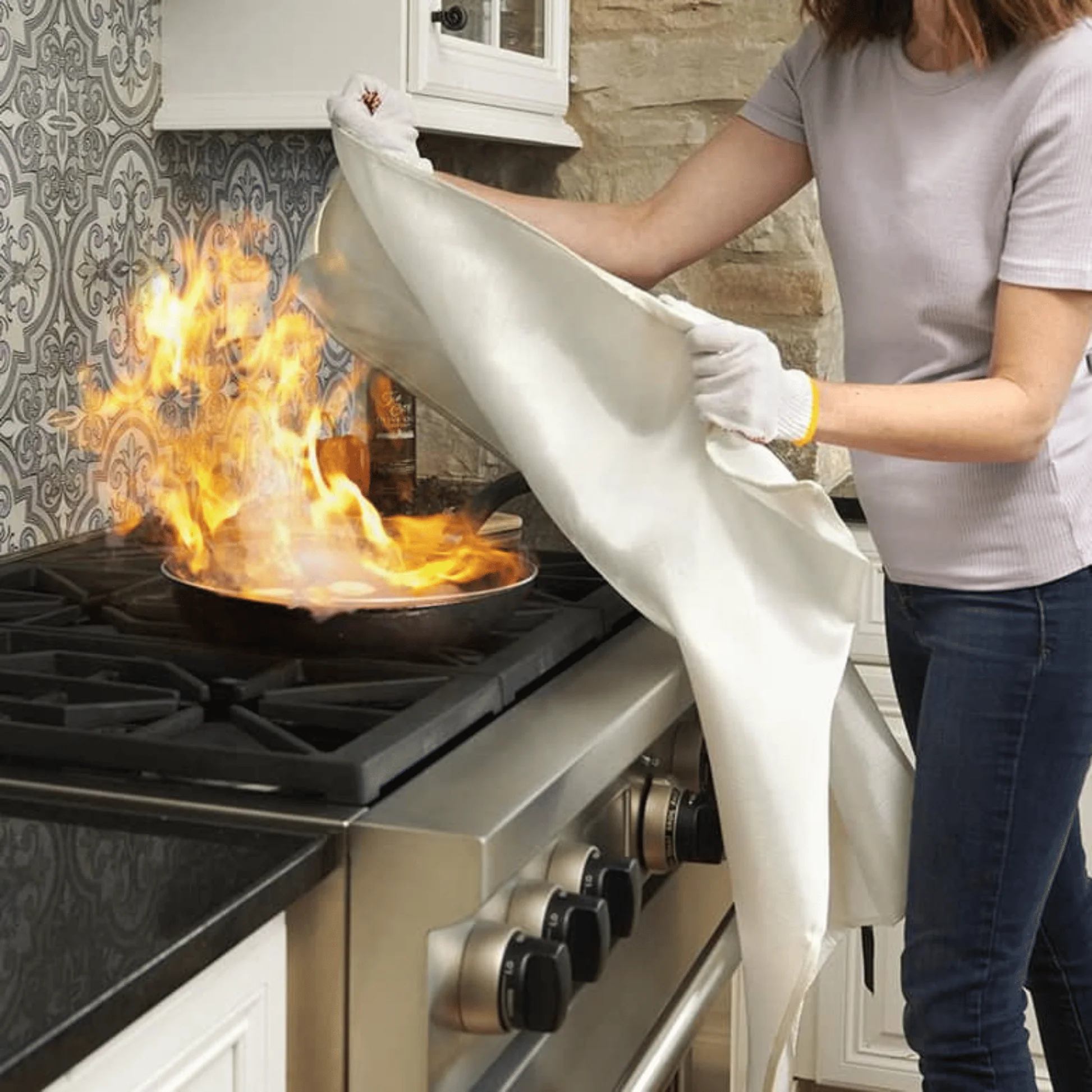
- a small fire in a frying pan or other cooking vessel,
- a small fire in a contained bin or container,
- a small fire on a flat surface that can be completely covered.
If the flames are larger than the blanket, the fire is spreading, or the fire cannot be completely covered, do not attempt to fight it with a fire blanket. Leave the area and call 112.
If a fire blanket is not suitable and a trained person can intervene safely, an appropriate fire extinguisher should be selected for the specific type of fire.
2. Clothing on Fire
When a person’s clothing catches fire, the basic immediate action is stop, drop and roll. The person should not run, because movement can intensify the flames.
A second person may use a suitably large fire blanket to help smother the flames by covering the casualty and restricting the supply of oxygen. Wrapping the person in a blanket and stop, drop and roll should not be presented as two consecutive stages of the same procedure. They are methods of smothering the fire that are used according to the circumstances.
For use on a person, EN 1869:2019 considers blankets with a minimum size of 1.2 × 1.8 m suitable. After the flames have been extinguished, burns require prompt medical assessment and emergency assistance should be requested when necessary.
When Not to Use a Fire Blanket
Do not use a fire blanket when:
- the fire is large or spreading rapidly,
- there is no safe escape route,
- dense smoke or hazardous fumes are present,
- the fire or burning object cannot be completely covered,
- approaching it would require you to move through excessive heat or flames,
- you do not know how to use the blanket correctly or have any doubt about whether intervention is safe.
If the situation is not immediately controllable, evacuate and call 112.
Lithium-ion batteries: A standard fire blanket complying with EN 1869:2019 should not be considered a general solution for lithium-ion battery fires. Thermal runaway, the possibility of re-ignition and the need for cooling create different firefighting requirements. If a product is promoted for a specific lithium-ion application, its test evidence and limitations should be clearly documented.

How to Use a Fire Blanket
Always follow the manufacturer’s instructions and local fire-safety training.
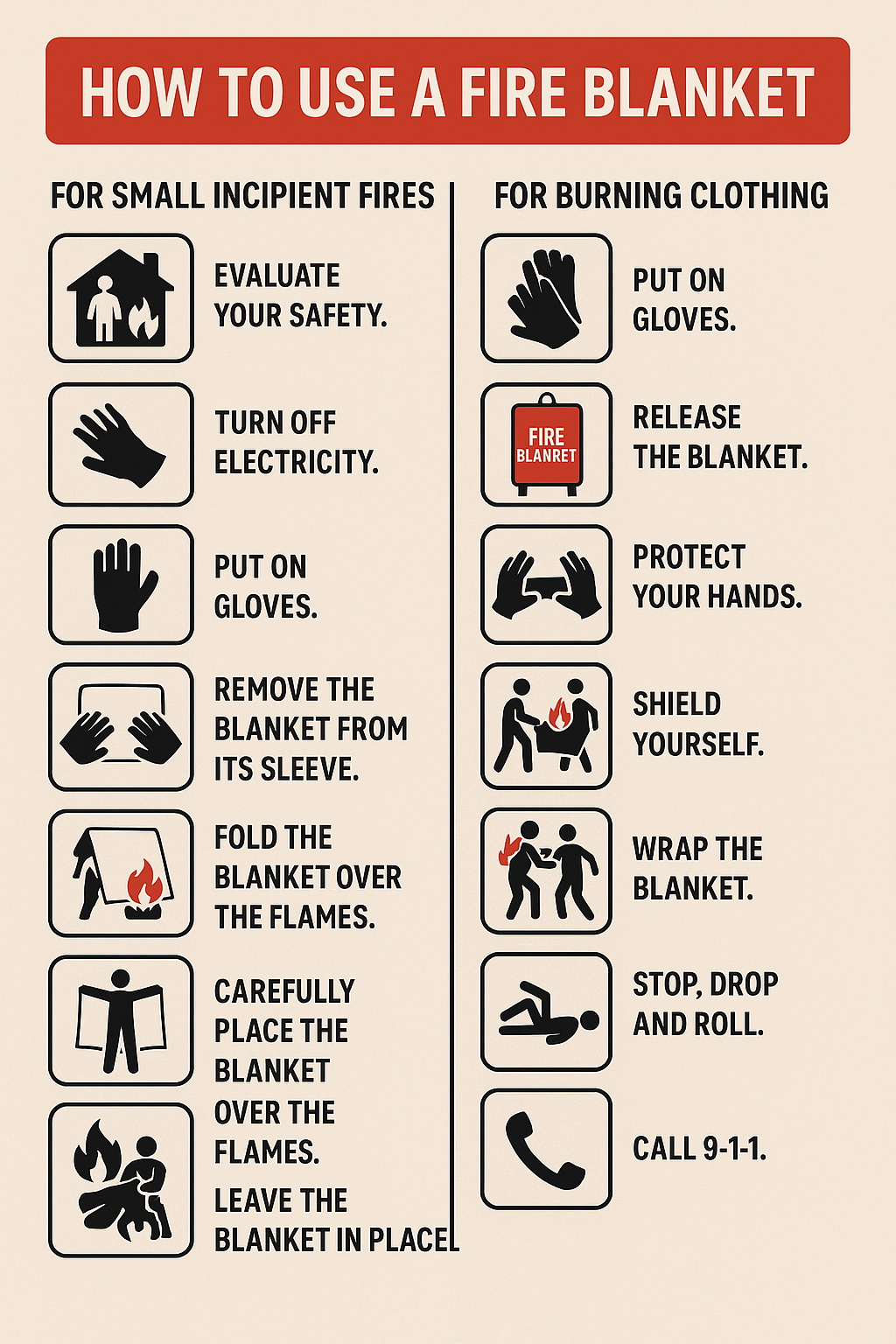
A. For Small Fires
- Assess your safety first. If the fire has already grown, heavy smoke is present or you do not have a clear escape route, leave the area.
- If it is safe to do so, turn off the heat source. Do not move a burning pan.
- Never pour water onto burning cooking oil or fat.
- Remove the blanket from its container according to the manufacturer’s instructions and keep your hands protected behind the material or the designated hand-holding areas.
- Approach carefully and place the blanket over the fire so that it is completely covered. Do not throw it from a distance.
- Do not lift the blanket to check whether the fire has gone out. Leave the fire covered until it has cooled, following the manufacturer’s instructions.
- If there is any sign that the fire is spreading, re-igniting or has not been fully controlled, leave the area and call 112.
B. For Clothing Fires
If clothing catches fire, the immediate instruction is stop, drop and roll. Do not allow the person to run.
If another person is available and a suitably large fire blanket can be used safely, it may be used to smother the flames by covering the casualty and restricting the supply of oxygen.
Do not instruct a person who has already been wrapped in a fire blanket to roll while wrapped in it. The blanket technique and stop, drop and roll are alternative methods of smothering flames according to the situation.
For use on a person, select a blanket of at least 1.2 × 1.8 m in accordance with EN 1869:2019. Once the fire has been extinguished, arrange medical assessment for burns and call 112 when emergency assistance is required.
Where to Keep a Fire Blanket
A fire blanket should be kept in a clearly visible and readily accessible location, close to the area where it may be needed but not so close that a fire could prevent access to it.
Typical locations include:
- domestic and commercial kitchens,
- workshops or workplaces where the risk assessment identifies a need for a fire blanket,
- boats or caravans where the selected product and its location are appropriate for the particular risk.
Fire blankets are available in different sizes, for example approximately 1.0 × 1.0 m, 1.2 × 1.2 m and 1.2 × 1.8 m. The appropriate size should be selected according to the foreseeable fire risk and the manufacturer’s instructions. For extinguishing burning clothing on a person, EN 1869:2019 specifies a minimum suitable size of 1.2 × 1.8 m.
Fire Blankets in the European Union
The current European standard for fire blankets is EN 1869:2019. It covers non-reusable fire blankets intended to be used by one person for controlling small fires. When sufficiently large, they can also be used to smother flames on a person’s clothing.
When selecting a fire blanket, check for:
- a declaration of conformity with EN 1869:2019,
- clear manufacturer and product identification,
- the actual dimensions of the blanket,
- clear instructions and pictograms,
- a suitable protective container and easy release system,
- instructions for inspection, storage and withdrawal from service.
A common application is a small fire involving cooking oils or fats, classified as Class F under the European fire-classification system.
In commercial kitchens, a fire blanket does not replace other fire-protection equipment or fixed systems required by the applicable fire-safety design, installation or national requirements.
Is a Fire Blanket Reusable?
No, when the product is a fire blanket complying with EN 1869:2019. The standard covers non-reusable fire blankets. After actual use on a fire, the blanket should be withdrawn from service and replaced in accordance with the manufacturer’s instructions.
If the blanket has merely been removed from its container without being exposed to fire, do not automatically assume that it can simply be folded and put back. Check the manufacturer’s instructions regarding inspection, correct folding and repacking.
What to Remember
A fire blanket is a useful first-response device only while the fire remains small, contained and capable of being completely covered. It does not replace the correct fire extinguisher, early warning, an evacuation plan or appropriate training.
- Select a product declaring conformity with EN 1869:2019.
- Keep it clearly visible and immediately accessible.
- Select a size appropriate to the foreseeable fire risk.
- For burning clothing on a person, use a suitably large blanket, at least 1.2 × 1.8 m in accordance with EN 1869:2019.
- Do not lift the blanket prematurely after covering a fire.
- Replace the blanket after actual use on a fire.
- If the situation is not immediately controllable, evacuate and call 112.
Disclaimer: This article provides general fire-safety information for educational purposes. Always follow the instructions supplied with the specific product and the applicable fire-safety requirements.
Last updated: 30 August 2026