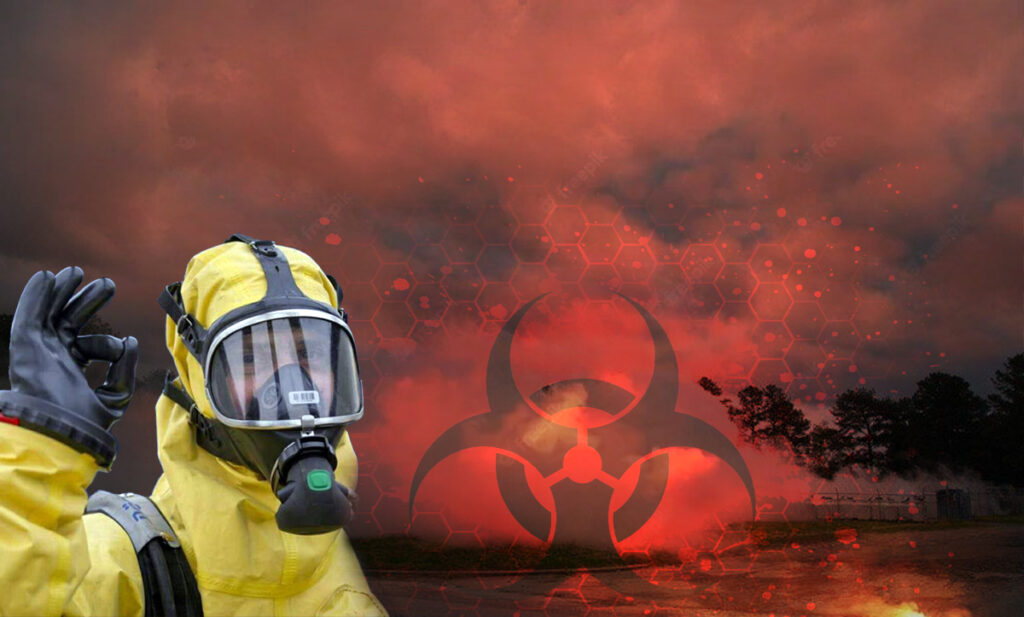
The ability to communicate with rescuers, firefighters, or workers in refinery facilities has always been a headache for supervisors, safety technicians, and other personnel involved in emergency operations.
Every form of communication requires knowledge both of the equipment used (such as walkie-talkies) and of hand signals that allow non-verbal understanding. Looking back historically, one common method in the fire service was the use of a remote speaker microphone. In some older configurations, the user had to move a hand out of the chemical suit sleeve to operate the radio microphone and communicate with the scene officer.
Communication Equipment in Chemical Suits
The use of portable transceivers inside chemical suits has been adopted by many services and tested over the years, revealing both good and bad practices as technology evolved.
Microspeakers, laryngophones, bone-conduction microphones, and even unique prototypes have been tested inside chemical suits, producing many stories that range from the amusing to the serious.
Today, several private and public services use full-face masks equipped with integrated or mask-mounted communication systems. Depending on the approved configuration, these can provide team intercom, voice amplification and connection to a tactical radio through a Push-To-Talk (PTT) interface.
Many current communication systems can interface with a wide range of VHF/UHF, DMR or TETRA radios, but compatibility is not universal. The radio, cable or wireless interface, mask communication unit and any required ATEX/IECEx approval must be verified as an approved combination for the intended environment.
The Question of System Failure
But the crucial question remains: what happens if all these communication systems fail during a hazardous operation?
For hazardous-material emergency response, operators should not enter a hazardous area alone. The buddy system is a well-established control: for example, OSHA HAZWOPER 29 CFR 1910.120(q)(3)(v) requires operations in hazardous areas to be performed in groups of two or more, with backup personnel ready to assist or rescue. Routine industrial maintenance outside emergency response must instead follow the applicable site risk assessment, Permit to Work and local legal requirements; there is no single universal “one-person” exception.
Let’s imagine a scenario involving two firefighters wearing chemical suits in a chemical industry setting. They are called to manage a dangerous incident with unknown parameters. Communication, both between them and with the scene officer, is vital.
Even if they have intercom and radio equipment, various problems may arise.
Possible Causes of Communication Failure
Electromagnetic Pulse (EMP)
Let’s begin with the most unlikely but theoretically possible event—an electromagnetic pulse (EMP). A sufficiently strong EMP can disrupt, degrade or damage susceptible electronic and communication systems, but it does not mean that every electronic device will fail. The effect depends on the pulse, shielding, cabling, antenna characteristics and equipment sensitivity. This scenario is far more relevant to defence and critical-infrastructure resilience than to a typical rescue operation, but it remains a useful extreme example of why a non-electronic fallback method can be valuable.
Malicious Actions
Malicious interference is a real risk, as experienced by security forces and fire services during various operations.
Malicious Actions | Signal Interference
An individual with the knowledge of a service’s frequency and undertones could intentionally jam transmissions, disrupting communication between rescuers, scene officers, and command centers. This is a criminal act but can still occur.
Malicious Actions | Signal Blocking Devices (Jammers)
Jammers intentionally transmit radio-frequency energy in or near a target band in order to interfere with or prevent normal wireless reception.
Unauthorised jamming is prohibited in many jurisdictions because it creates harmful interference. In the European Union, radio equipment is subject to the Radio Equipment Directive and spectrum rules intended to prevent harmful interference, while equipment used exclusively for public security, defence or State security may fall under separate national arrangements. For that reason, jammer legality should not be described as identical in every country.
Industrial Electromagnetic Fields
High-voltage installations can produce electromagnetic fields and radio-frequency noise that may degrade communication under some conditions. The effect depends on the source, distance, equipment immunity, antenna system and operating frequency.
Industrial Electromagnetic Fields | Corona Effect
The corona effect occurs when the electric field around high-voltage lines becomes strong enough to ionize the air, creating discharges along the surface of conductors. This can cause:
- Radio and TV interference
- Energy losses
- Audible crackling sounds
- Visible discharges at night
- Wave distortion
- Production of corrosive substances such as ozone and nitrogen oxides
Though rare, these effects can affect communication equipment near power lines.
Structural Interference
Incidents in tunnels or METRO stations present another challenge. While many facilities are designed to support radio frequencies, concrete, metal, and other construction materials can block signals or reduce range.
In tunnels and underground structures, radio coverage may require repeaters, leaky-feeder systems or other dedicated infrastructure. ATEX/IECEx-certified transceivers are required only where the hazardous-area classification and applicable rules demand explosion-protected equipment; ATEX certification does not solve a radio-coverage problem by itself.
Hardware Failure
A hardware failure occurs when equipment does not perform as designed.
Examples include:
- Short battery life despite full charge indications
- Inability to transmit at the required distance
- Malfunctioning PTT buttons
- Improperly fitted or dropped earpieces
Note: ATEX certification does not impose a universal 1 W maximum transmitter power. Output power varies by approved radio model, frequency band, gas group and Ex configuration. Current certified radios exist with different power settings, so range should be evaluated from the manufacturer’s approved specification and the actual site radio design.
Equipment Damage
Equipment damage can occur during operations due to physical impacts or wear.
Examples include:
- Damaged antennas or amplifiers
- Malfunctioning transceiver circuits or intercom masks
- Battery leakage causing corrosion and current loss
These issues can lead to partial or total loss of communication during an operation.
The Need for Backup Communication: Hand Signals
Given all these potential failures, it is clear that the loss of radio communication inside a chemical suit is a realistic possibility. To address this, rescuers must have a reliable backup method.
Hand signals have long been used in safety, shipping, fire and industrial operations. Chemical-suit and HazMat teams have also developed agency-specific signalling systems, but there is no single internationally adopted set used by every service.
An older 2012 presentation by Yazid Bin Ismail proposed several gestures for hazard communication, and other HazMat organisations have documented their own local hand-signal sets. The seven signals presented below were developed and tested during our workshop in Greece and were subsequently published by the Hellenic Fire Service as an alternative communication method for operations involving chemical protective suits. They should not, however, be described as a universal or internationally standardised signalling system.
Development of the Seven Hand Signals
In May 2022, a special CBRNE seminar was held at Dräger in Greece, attended by ten officers from the 1st and 2nd EMAK (HSDRU*) of the Fire Department.
During this seminar, we conducted a workshop on communication for chemical suit operators. Together, we developed and tested more than twenty possible hand signals.
Ultimately, we selected seven essential hand signals—simple, memorable, and sufficient for most emergency situations.
A short educational video was produced for training purposes. It is important to note that this video is unofficial and purely educational.
The training video was subsequently published by the Hellenic Fire Service on its official website as an alternative method of communication using seven hand signals during operations with chemical protective suits. The Fire Service also stated that the ten personnel trained in the procedure would be called upon to train other firefighters assigned to similar incidents. This official publication and training use should not be confused with an international standard: organisations outside the Hellenic Fire Service should still evaluate, train and formally incorporate the signals into their own procedures before operational use.
Operational note: These seven signals were officially published by the Hellenic Fire Service as an alternative communication method for chemical protective suit operations. They are intended as a backup when normal communications are unavailable and should be trained and practised before operational use. They do not replace approved radio procedures, emergency alarms or Incident Command communications, and they are not presented as an international standard.
Analysis of the Seven Hand Signals
1. “Are You Okay?”
- Meaning: The operator asks a colleague or scene officer if everything is okay.
- Movement: Form a fist and tap the top of the head three times.
- Notes: The operator must look directly at the person being addressed. The same signal can be used as a reply.
2. “No Air”
- Meaning: The operator has lost air supply or is experiencing a breathing apparatus failure.
- Movement: With an open palm, move the hand horizontally across the neck area or below the eyes three times.
- Notes: Immediate assistance is required. Always maintain eye contact with the person being alerted.
3. “Danger in Area”
- Meaning: Indicates the presence of danger (e.g., chemicals, explosives).
- Movement: Raise both hands and cross them in front of the visor to form an “X.” Repeat the gesture three times with short pauses.
4. “Need to Exit Suit”
- Meaning: The operator must leave the suit immediately due to distress or malfunction (e.g., nausea, overheating, equipment failure).
- Movement: Make circular outward movements with both thumbs extended, indicating the need to remove the suit.
- Notes: Immediate intervention is necessary, as the operator may lose consciousness.
5. “Need Help”
- Meaning: Indicates that the operator requires assistance.
- Movement: Raise both hands above the head to form a “V” shape, repeating the gesture three times.
- Notes: This signal may indicate the need for support from additional personnel.
6. “Stretcher Needed”
- Meaning: A casualty has been found, and a stretcher is required.
- Movement: Mimic lifting a stretcher by moving both hands up and down as if holding its handles.
7. “Danger—Evacuate”
- Meaning: Immediate danger requiring evacuation of all personnel.
- Movement: Raise both arms outward and wave them repeatedly, similar to a “flying” motion, while approaching others quickly.
- Notes: This signal warns everyone in the hot zone to retreat immediately to the cold zone.
Summarizing all of the above, it becomes clear that losing communication during an incident while inside a chemical suit is a real possibility.
The seven hand signals described here provide a simple and memorable backup method for chemical suit operators to communicate vital information when normal communications are lost. Following their development and testing in Greece, the method and training video were published by the Hellenic Fire Service for alternative communication during chemical protective suit operations. They are not presented as an internationally standardised signalling system; organisations using them should ensure that personnel are trained and familiar with the signals before operational deployment.
I would like to thank the officers and firefighters of EMAK (HSDRU*) and the Fire Department for their cooperation, professionalism, and enthusiasm in developing this system.
Above all, I wish health, safety, and longevity for all members of the security forces who work daily under the most difficult conditions.
Si vis pacem, para bellum…
* HSDRU: Hellenic Special Disaster Response Unit, part of the Hellenic Fire Service.
Technical References and Review Sources
- Hellenic Fire Service, Alternative communication with seven hand signals during operations with chemical protective suits, official publication, September 2022.
- OSHA, 29 CFR 1910.120 — Hazardous Waste Operations and Emergency Response, including the buddy-system requirement for hazardous-area emergency response.
- Dräger, C-C440 communication control unit and current FPS-COM communication-system documentation: radio compatibility depends on the approved interface and configuration.
- Dräger, FPS-COM 7000 approval documentation: intrinsically safe operation requires an approved intrinsically safe radio and approved cable/interface combination.
- Motorola Solutions, MOTOTRBO R7Ex ATEX/IECEx datasheet, showing that ATEX-certified portable radios do not have a universal 1 W RF-power ceiling.
- U.S. Department of Energy, EMP resilience guidance: electromagnetic pulses can disrupt or damage susceptible electronics, but effects are equipment- and exposure-dependent and do not imply failure of every electronic device.
- European Union, Directive 2014/53/EU on radio equipment, including requirements related to spectrum use and harmful interference and exclusions for certain public-security/defence uses.
- Other HazMat organisations and fire-service SOPs also document agency-specific hand-signal systems; this supports distinguishing the Hellenic Fire Service method from an internationally standardised signalling system.
Last technical review: August 2026.