
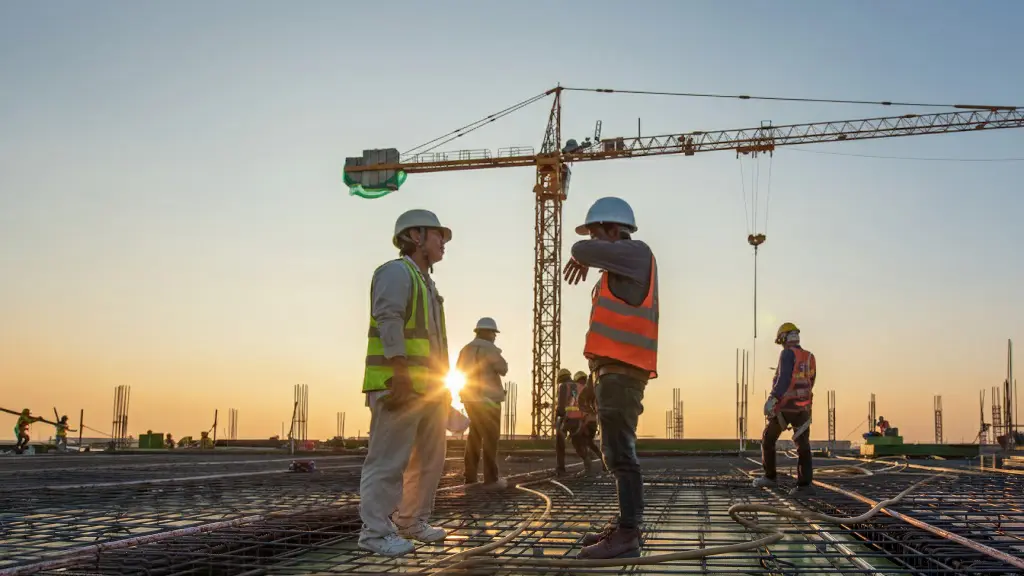
In high risk projects, procedures, KPIs, audits, and compliance targets are often discussed. Importance is not denied. Yet, in demanding operational environments, it is repeatedly shown that safety is not built by paperwork alone.
Strong performance is built through relationships, frank communication, and a shared understanding of roles long before an emergency is faced.
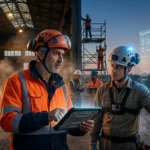
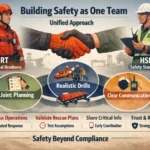
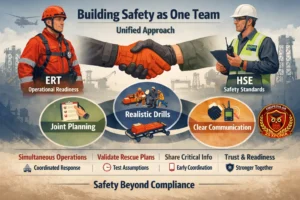
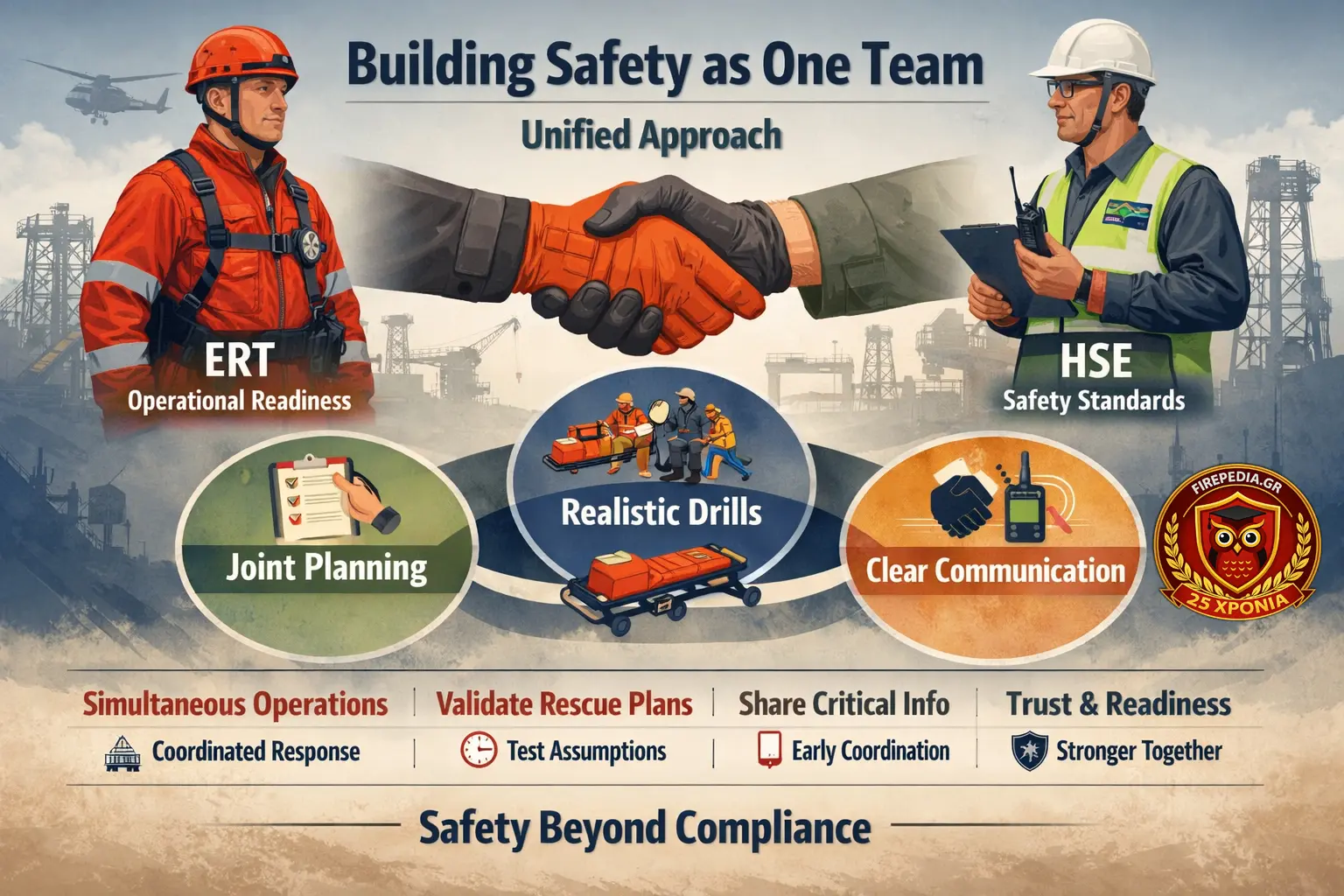
Across complex sites where SIMOPS, meaning simultaneous operations, are carried out, a consistent pattern has been observed. The strongest safety outcomes are achieved when Emergency Response Teams, ERT, and HSE are not treated as separate functions, but are operated as one technical team.
Planning Must Be Connected to Operational Reality
Structure, methodology, and standards knowledge are typically brought by HSE. An equally valuable operational perspective is brought by ERT. Field access is seen as it truly exists, evacuation time is judged as it actually unfolds, and the gap between written theory and real conditions is exposed.
No advantage is held by one role over the other. Instead, completion is provided through combination.
When ERT is involved early, during walkdowns, risk reviews, and planning meetings, planning is reshaped. Emergency response is not left as an attachment to a document. It is designed into the work itself. By that shift, larger problems are often prevented later.
Emergency Plans Must Be Grounded in Reality
An Emergency Response Plan should not be produced only to satisfy a requirement. Clarity and practicality must be ensured for the people who will depend on it under pressure.
When close collaboration is maintained between ERT and HSE, details that are commonly underestimated can be tested.
- Can a stretcher be passed through the planned access route?
- Are response times being assumed, or being validated?
- Is equipment being placed where it will actually be needed?
- Will communication be maintained with noise, stress, and distance present?
These questions are not always captured in procedures. Yet, when seconds are lost, consequences are felt.
A Recurrent Issue in Complex SIMOPS Sites
On large projects involving multiple contractors, a recurring weakness is often revealed. A lack of planning is rarely the core issue. Instead, the timing and flow of safety preparation tend to be mishandled.
Tight schedules and clear work plans are usually maintained by contractors. However, safety documentation, such as Job Safety Analyses, JSAs, and Work Method Statements, WMS, is not always shared early enough with ERT. When this information is withheld or delayed, a realistic rescue approach cannot be fully built, and gaps can be left undiscovered.
In some cases, rescue procedures are agreed in documentation but are not fully followed once work begins. Intent is rarely malicious. More often, pressure is applied by production demands, priorities are shifted, or safety planning is assumed to be finalised later.
When early collaboration is established, the dynamic is changed. Risks are anticipated sooner, practical improvements are proposed, and support is offered to contractors instead of last minute reaction being forced.
Safety is made smoother, not heavier.
Silo Thinking Must Be Broken
On large projects, an invisible line is often drawn between departments. When HSE is treated only as enforcement and ERT is treated only as standby response, knowledge is separated and opportunity is lost.
When both teams are presented together, during toolbox talks, exercises, and routine site presence, a shift is often created. Safety is less likely to be seen as control, and more likely to be experienced as support. Earlier feedback is provided, smaller issues are surfaced, and escalation is prevented.
That cultural change is subtle. Its impact is not.
Leadership Must Be Built Through Training and Review
Joint drills and realistic simulations are often scheduled as requirements. Yet their true value is found elsewhere. Team performance is revealed under pressure.
With each exercise, something is usually uncovered, a communication gap, a logistical delay, or a simple adjustment that changes outcomes. When lessons are reviewed together by HSE and ERT, improvement is accelerated and blind spots are reduced.
Trust is built through repetition and shared learning. In emergencies, trust is often the most critical tool that is carried.
As a conclusion, technical leadership in safety is not defined by titles or authority. It is defined by connection between people who hold different parts of the same system.
When ERT and HSE are operated as a unified technical ecosystem, safety is moved beyond compliance and is strengthened as part of operational performance.
In complex environments with multiple contractors and simultaneous activities, early communication, realistic planning, and mutual respect must be treated as essential. Because safety is not owned by one team alone. It is built together, every day, through the way work is organised and carried out.
George Tasios
FIREFIGHTER/EMT-I
Course Director ERC
ALS (I.P) ERC
PHTLS INSTRUCTOR
TEACHER IN COMPREHENSIVE EDUCATION